Thursday, May 9, 2019

Part Nine


“Man, it’s flat out there!!”

My iPhone wakes me up at 6am PDT. It’s 9am EDT back home. Yup, my body clock is still on East coast time. And that’s OK with me.

I open the curtains to my hotel room and the sun is out. Just then I hear a rumbling sound. I see there are train tracks about 50 yards away. And to my delight, a Union Pacific double-stack train with three EMD locomotives goes roaring by. A very nice way to start my day.

At 7am, we are on the coach buses as we continue our journey to our next stop of Ogden, Utah, some 4 ¼ hours away. Along the way, we cross the Nevada/Utah state line:


entering the Mountain Time Zone, and the Bonneville Salt Flats. From our friends at Wikipedia.Org:

“The Bonneville Salt Flats is a densely packed salt pan in Tooele County in northwestern Utah. The area is a remnant of the Pleistocene Lake Bonneville and is the largest of many salt flats located west of the Great Salt Lake. The property is public land managed by the Bureau of Land Management and is known for land speed records at the "Bonneville Speedway". Access to the flats is open to the public.

"Geologist Grove Karl Gilbert named the area after Benjamin Bonneville, a U.S. Army officer who explored the Intermountain West in the 1830s.In 1907, Bill Rishel and two local businessmen tested the suitability of the salt for driving on by taking a Pierce-Arrow onto the surface of the flats.

"A railway line across the Bonneville Salt Flats was completed in 1910, marking the first permanent crossing. The first land speed record was set there in 1914 by Teddy Tetzlaff.”

More about the Bonneville Salt Flats can be found at https://en.wikipedia.org/wiki/Bonneville_Salt_Flats

The salt flats are huge.  


So huge in fact, you cannot see some of the flats due to the curvature of the Earth. And there is lots of water there, most likely because of the winter’s melting snow. But come August when the water is gone, the salt flats are opened to the public and the racing begins at the Bonneville Speedway. Again from our friends at Wikipedia. Org:

“Bonneville Speedway (also known as the Bonneville Salt Flats Race Track) is an area of the Bonneville Salt Flats northeast of Wendover, Utah, that is marked out for motor sports. It is particularly noted as the venue for numerous land speed records. The Bonneville Salt Flats Race Track is listed on the National Register of Historic Places.

“The salt flats were first used for motor sports in 1912, but did not become truly popular until the 1930s when Ab Jenkins and Sir Malcolm Campbell competed to set land speed records.
“A reduction of available racing surface and salt thickness has led to the cancellation of events at Bonneville, such as Speed Week in 2014 and 2015. Available racing surface is much reduced with just 2.5 miles (4.0 km) available instead of the 9-mile (14 km) courses traditionally used for Speed Week.”

More about the Bonneville Speedway at https://en.wikipedia.org/wiki/Bonneville_Speedway

Once clear of the salt flats and before Ogden, we were along the southernmost end of teh Great Salt Lake:


We swung south of Ogden to Heber, Utah, home of the Heber Valley Railroad. Back to our friends at Wikipedia.Org:

“The Heber Valley Railroad (HVRX) is a heritage railroad based in Heber City, Utah. It operates passenger excursion trains along a line between Heber City and Vivian Park, which is located in Provo Canyon. The HVRX carries over 110,000 passengers a year.


“The railroad line is approximately 16 miles (26 km) long. A typical round trip ride on the train takes about 3 hours. There are a total of four passing sidings outside of the Heber yard limit. Notable landmarks seen from the train include Mount Timpanogos, Cascade Mountain, Deer Creek Dam and Reservoir, Provo River, Sundance Ski Resort, Tate Barn, and Soldier Hollow. A variety of wildlife including deer, eagles, fox, moose, turkeys, hawks, mountain lions (cougars), and beavers, have all been seen from the train as well.

“The line operated by the HVRX was formerly part of a Denver and Rio Grande Western Railroad branch line that connected Heber City to Provo, Utah. The branch line was completed in 1899 and operated freight and passenger service until the line's abandonment in 1967.

“The line was saved for tourist use and was reopened in 1970 when No. 618 and other equipment were brought up the line from Provo. The track between Provo and Vivian Park was later removed and converted into a recreational trail. During the 1970s and 1980s the railroad operated as the "Heber Creeper". In the late 1980s this railroad went out of business.

“Citizens in the Heber area successfully petitioned the State of Utah to help save the railroad, leading to creation of the Heber Valley Historic Railroad Authority in the early 1990s. Since this time the railroad has seen considerable growth. The railroad operates as a non-profit 501(c)(3) organization.

“During the 2002 Winter Olympics the railroad was part of the Olympic Steam Team, carrying spectators to the Soldier Hollow Olympic venue. The railroad's No. 618 and 75 steam-engines were joined by the Nevada Northern Railway Museum's No. 93 steam-engine, in pulling eight-car trains full of passengers, to the Soldier Hollow depot where they disembarked and continued to the venue entrance on a horse-drawn sleigh. The day prior to the Opening Ceremony of the games, all three locomotives were combined into one triple-headed train, and used to transport the Olympic flame from Soldier Hollow to Heber City as part of the torch relay.”

More on the Heber Railroad can be found at https://en.wikipedia.org/wiki/Heber_Valley_Railroad

Oh, and one other thing, we were held up on the train….not quite literally. Seems there are some actors who protruded two cowboy bank robbers complete with guns and rifles and boot spurs. They put on their little routine which was quite funny. Afterwards, I spoke to our tour guide Hannah and I that you guys had planned everything for this trip. She was totally unaware that the “robbery” was to occur. Still, all of us on the tour got quite a kick out of it.

Anyway, we made it to Ogden and The Bigelow Hotel where we were told about the history of the hotel and had a marvelous meal. All in all, a very full day.

Thursday it is over to Ogden Union Station where the world will meet and greet the restored Union Pacific Big Boy #4014 and its smaller brother #844. LOTS of railfans and the public. We’ll talk to you then.

I am Philip J Zocco. On The Road. In Ogden, Utah.

Part Eight


“The wheels on the bus go ‘round and ‘round”

What Mommy or Daddy has not sung that tune to their children in their young years? Well today, we senior citizens, otherwise known Trains Magazine/Special Interest Tours, are rolling on our next event of our journey to Heber Valley, Utah to ride a steam train this afternoon. More on that in tomorrow’s blog.

Tuesday was an eventful day. It began with all of us talking a 0.3 mile walk to the Sacramento Valley Station to board our train for the day, Amtrak #6, the California Zephyr. SVS is host to the local Sacramento trolley line and to the Amtrak California service which are trains that serve the major California cities. A few of their trains were at the station waiting to begin their railroad day.


BTW, Amtrak locomotive #150, leading our California Zephyr. gets around as do all of of the P40's. This particular locomotive I saw in Ashland, Virginia last year. Lots and lots of miles.

Once upon our private cars to our next overnight stop of Elko, Nevada, we now had all 70 participants in the Special Interest Tours. The now 2 sleepers, Pacific Union and Berlin, were converted to seating compartments and everyone was asked to rotate with those in Super Dome #53 so that everyone could experience seeing the scenery as it rolled by.

About a half hour after leaving SVS, we started to make the slow climb into the mountains towards Donner Summit. Number Six weaved its way like a serpent. Lots of tight curves and few straightaways. Then came the numerous tunnels and a few snow sheds. And then we approached Donner Pass. 


A lot of us thought about the Chinese workers who did the construction of this route. Clearing the right-of-way with only shovels, picks, axes and long saw blades. In the tunnels, this was by far the most dangerous part of building the railroad. A large iron rod, with a four point star cutter point, was held by one worker with the star against the granite wall and another worker hammering at the other end with a 10-pound sledge hammer to drill the holes for black power. The rod would be turned a little bit and the sledgehammer swung again. There were no compressed air drills in the 1860’s. All of this was manual labor. Somedays the Chinese were lucky if they removed ONE INCH of granite from the wall they were attacking. And once the holes were drilled, black power was used to excavate the granite. Dynamite had yet to be discovered. And black power was dangerous and unpredictable. Fuses would sometimes go off prematurely, take longer than expected, or not at all. Many labors would lose their lives. Still, the railroad had to be built.

Once out of the mountains, it was a schedule stop at Truckee, California.  After that was the city of Reno, Nevada, known as “The Biggest Little City in the World”. But, we couldn’t see the city. Seems the city fathers were tired of trains tying up the grade crossings, especially freight trains. So a concrete trench was put in place for the train tracks to go and the station was put on top of the trench. 


We were allowed about 10 minutes for a rest stop and soon after we were back on the Zephyr and by 9:31pm PDT, we were at our overnight stop in Elko, Nevada.

Wednesday, we head to Heber, Utah for a ride on the Heber Valley Railroad then on to Ogden, Utah for the welcoming of Union Pacific’s Big Boy locomotive #4014.

We are hallway thru our journey. Time does fly when you’re having fun.

I am Philip J Zocco. On The Road. In Elko, Nevada.

Tuesday, May 7, 2019

Part Seven

A VERY Long Day. More Visiting. Seeing History.

Sunday was just that kind of day. It wasn’t planned that way. It just happened that way. Still, there were some good parts to the day.

One thing before we go on. My body clock is still on East Coast time.  Turning in at 9pm and getting up at 6am is not the norm for me. But the things have been happening on this trip, it has helped quite a bit…..until today.

Our group met at the Bob Hope airport train station at 10am PDT. We were scheduled to board our private cars attached to Amtrak train #14, the Coast Starlight, at 10:29am. That didn’t happen. Our tour guide Adam was on the phone with his people and before the train even left Los Angeles Union Station, the air compressor, which provides air to operate the train’s brakes, on the lead locomotive failed. Departure time for LA was now delayed one hour as a replacement locomotive was located and hooked up. Add to that some more delay and the train finally departed LAPU at 11:22am PDT. Twenty nine minutes later, number 14 was at Bob Hope Airport station and we got on board our private cars. And on we went. While at BHA, I got a few shots:


The towns that we went thru are part of the country’s fruit belt. Acres and acres of strawberries could be seemed along with acres of cabbage and lettuce. Soon after, number 14 was hugging the California coastline with beaches and campsites along the way.  This is serpentine track.


Our train moved along like a snake swimming thru the wild grasses. Oil well platforms could be at the Earth’s edge of the Pacific Ocean. All I could think of was ‘Next stop, Hawaii”.


Upon departing Paso Robles, California after a 10 minute stop, our train began a very unique journey. We started to climb quite a bit and went around these very tight horseshoe curves to the point that the higher we rose, you could see the train track and the valley that we climbed out of. Highway 101 was crawling northbound and we had the advantage on those drivers. After going thru a series of short tunnels, we finally topped out and continued our journey.


As we continued, our train lost a little more time here and there to the point that instead of arriving at 11:59 PM PDT in Oakland, It was now 2:20am PDT when we finally arrived at Sacramento Valley Station. By the time I got to my hotel, took a lovely hot shower and crawled into bed, it was 6:18am EDT. Sorry, but my body clock is still on East Coast time. 

Monday morning I got up at 10am PDT. Man, did I sleep well!! Once up and about, it was time to meet another old friend from Channel 8 whom I had not seen since his departure in July 1997. His name was Scott Thompson who is originally from Tacoma, Washington. Scott works for the Pack 12 Conference in San Francisco. We met at the hotel and then walked over to the California State Railroad Museum. We joined the 11:30am tour of the museum and then it was on to grab some pizza and gets caught up on 21 years. Not enough time to say the least but it was great to see Scott again.
After we parted ways with my promise to swing back out here next year, it on to the big tour bus and a ride up to Donner Pass. Due to still a lot of snow in the area were we were supposed to do a walking tour, we were brought to the Donner Pass Visitors Center were we saw exhibits about the Donner Party and how the Chinese helped in building the Transcontinental Railroad. And Mother Nature deceived to add some fun with a combination of heavy rain and thunder hail which started to add up like slurry in the drainage ditches.


After the station, it was on to Truckee, California and a visit to the historic railroad town.named Truckee. While we are there, I could not help but see what I thought was an almost 20-foot high pile of dirt. Upon closer inspection, it was a HUGH pile of snow left from the past winter. One of the Truckee volunteers said it was twice as high 3 weeks before. Suffice it to say that had A LOT of snow.  We also took pictures of an old rotary snow plow and a steam-powered work crane.


The volunteers from Truckee were very helpful with their information. With the occasion rumble of thunder all around us, it was time to get on the buses and head back to Sacramento. We are treated to a cash bar and delicious dinner. We heard from the Trains Magazine representative, retired Kalmbach publisher Kevin Keefe, who set up the trip for us and we received 2 complimentary DVDs on the Transcontinental Railroad and Promontory Point.

And a little more about part of our trip. When we were on the Southwest Chief, we climbed a part of the railroad thru Raton Pass north of Albuquerque, New Mexico. You saw pictures of that back in Part 5. This single track sees only sees both Amtrak Southwest Chiefs. Nothing except for maintenance trains.

The track is in great shape. On the journey climbing up the pass, we lost our HEP, head-end power, which supplies electricity to the cars. The trailing P40 went offline as we were climbing the hill. Seems the locomotive overheated due to a missing cap on the radiator. We able to still continue climbing but at a reduced speed. By allowing some time for the locomotive to cool down, the fireman was able to restart the locomotive. Upon arrival in Albuquerque, the loco got a drink and all was OK after that.

Anyway, more traveling on Tuesday as we get back on our private cars and head to our next destination of Elko, Nevada. Along the way, we  will ride thru Donner Pass. Hope you are enjoying your reading. Please stay tuned.

I am Philip J Zocco. On The Road. In Sacramento, California.

Part Six


“I Love LA”

I Love LA is a song about Los Angeles, California co-written by Randy Newman and recorded by Newman. It was originally released on his 1983 album Trouble in Paradise. The hook of the song is its title, repeated, each time followed by an enthusiastic crowd cheering, "We love it!" 

And so it was that I am in Los Angeles for the very first time. I have been to the West coast before back in October 2006 but my first time to Southern California. It is nothing like I have seen or been to before.  The very first thing that caught my eye was the very tall and slender trunk palm trees. 


I mean, in all of the years that I have seen them through news stories or on TV or in movies, it is really quite cool and even cooler was arriving at what was known as LAPUT which is Los Angeles Union Station. Not only does Amtrak have its operations here but so does Metrolink commuter rail and the Amtrak California services which handles trains specificity for Southern and Central California. 

Part of my trip was seeing some old friends. My first was Sara Welch who is a general assignment reporter for KTLA-TV5, the Fox affiliate. 


I met Sara and her husband Bob and their 2-year old son Bo. We left LA and headed for Santa Monica and the world famous Santa Monica Pier. Breakfast was at the renowned Jinky’s just a couple of blocks from the pier and the Pacific Ocean.  French toast, home fries, tea and orange juice were on menu and were delicious. 

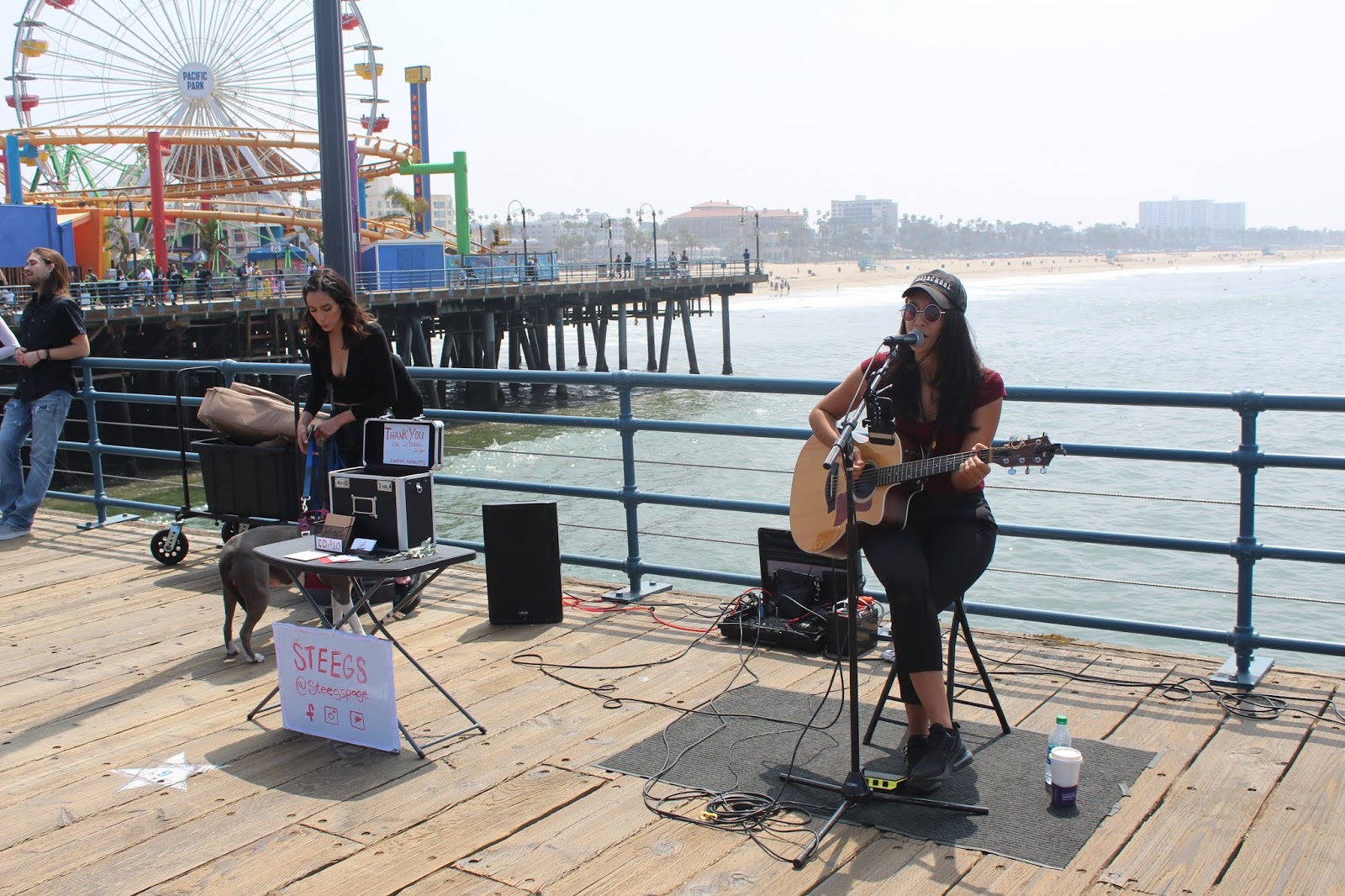
Once Sara and I said our goodbyes (busy family life), I proceeded to the Santa Monica Pier. The place was pretty crowded but it had a very festive atmosphere. One thing was the music. Three musicians were there working for their tips. 


The first was a young man who played a six string bass guitar with accompanying audio tracks playing from the speakers. The next musician was an older gentleman who was playing an alto saxophone, again with accompanying audio tracks playing from the speakers. The next musician was a young lady playing guitar and singing. All were just phenomenal. And a few more pics from the pier:


 After that it was on to the Metro Santa Monica station and I hopped aboard the Expo line to the 7th Street station near downtown LA. I then decided to get a Lyft ride which took me to the Marriott Burbank Airport Hotel in Burbank near the Bob Hope International Airport. Suffice it to say that my first hot shower in over two days was very refreshing was an understatement. Once scrubbed up, it was time for a nap on a very comfortable king size bed. Upon awakening, it was time to see the running of The Kentucky Derby. It’s weird when I would normally watch it at 6pm EDT when it is airing in the middle of the afternoon in Los Angeles. And even weirder is seeing a Stanley cup playoff game at 4:30pm PDT. 

At about 6pm, it was another Lyft ride, this time to Santa Clarita, California to meet up with my ham radio friend Dick Miller, KJ6W and his wife Lynne. Dick and I have known each other for almost 17 years but had only heard each other’s voice and we had never seen each other in person, or as we say in ham radio parlance, an eyeball-to-eyeball meeting. Dick and I first met on a radio/Internet system called IRLP, the Internet Radio Link System, which was created by David Cameron, VE7TLD of Vancouver, BC Canada, back in 1998. IRLP is a bunch of ham radio repeater systems that uses the Internet to tie it all together thru VOIP or Voice over Internet Protocol. So on this trip which was leading me to California, it was deemed that Dick and I were to finally meet. We met and had dinner at a restaurant called Rattlers and a nice 2-hour dinner. After that, it was another Lyft ride back to the hotel and the end of the day. Truly today, it was just great.

Sunday, it is back on the train from LA to our next location in Sacramento, California. The journey continues. Pleas e stay tuned.

I am Philip J Zocco. On The Road. In Los Angeles, California.

The Last Part

“Thanks for the Memories” The above was the theme for entertainer Bob Hope. His orchestra, Les Brown and His Band of Renown, played th...